

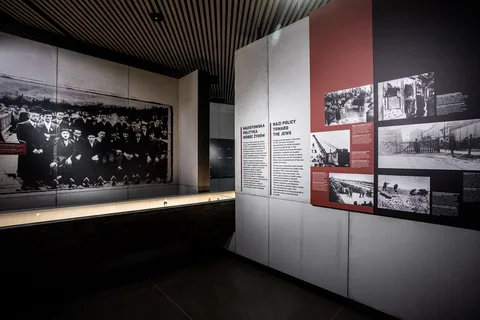
The Sobibor AR Exhibit represents a modern approach to preserving historical memory through immersive digital interpretation. Its purpose is not entertainment, spectacle, or technological novelty, but the ethical transmission of historical truth using tools familiar to contemporary audiences. By recreating the physical layout of the Sobibor extermination camp through augmented reality, the exhibit provides spatial understanding that traditional texts and photographs often fail to convey. The exhibit exists to ensure that memory remains tangible even as physical traces fade.
Sobibor as a Historical Site of Absence
Sobibor was designed by its perpetrators to erase evidence. Unlike other camps, it was dismantled almost entirely after the prisoner uprising. This intentional destruction left historians with fragments, survivor testimony, and archaeological remnants rather than intact structures. The absence itself became part of the historical reality. The AR exhibit responds to this absence by reconstructing what was intentionally removed, not to sensationalize, but to restore context.
Why Augmented Reality Was Chosen
Augmented reality overlays digital reconstructions onto physical or neutral space, allowing viewers to experience scale, distance, and orientation without fabricating false material presence. This method avoids building replicas that risk appearing theatrical or disrespectful. AR allows learners to see where buildings stood, how paths connected, and how confinement functioned spatially, while maintaining awareness that what they see is a reconstruction based on evidence.
Ethical Design Principles Behind the Exhibit
The Sobibor AR Exhibit is grounded in ethical restraint. The design avoids graphic imagery, dramatization, or reenactment of violence. The focus remains on environment, structure, and testimony rather than spectacle. Ethical consultation ensures that the technology serves remembrance and learning, not emotional manipulation. Silence, absence, and minimalism are intentional design choices.
Survivor Testimony as Structural Foundation
The reconstruction relies heavily on survivor testimony, particularly from individuals who participated in or survived the uprising. These testimonies provided measurements, relative positions, and daily movement patterns that informed the digital model. Rather than replacing testimony, the AR environment supports it by allowing users to visualize descriptions that were previously abstract.
Translating Memory Into Spatial Understanding
Many historical learners struggle to grasp how systems of oppression functioned physically. Spatial understanding reveals control mechanisms such as separation zones, controlled pathways, and visibility limitations. The AR exhibit transforms memory into orientation, helping users understand how the camp functioned as a system rather than a collection of isolated events.
Educational Objectives of the Experience
The exhibit is designed to support inquiry-based learning rather than passive consumption. Users are encouraged to explore, pause, reflect, and ask questions. The experience supports historical literacy, critical thinking, and ethical reflection. It is not a guided narrative with a beginning and end, but an environment that invites careful observation.
Classroom Integration and Pedagogical Value
In educational settings, the exhibit functions as a visual anchor for discussion. Teachers can contextualize historical documents, survivor accounts, and ethical questions using the spatial model as reference. This reduces abstraction and helps students connect testimony with lived environment. The AR experience supports multiple learning styles, particularly visual and spatial learners.
Addressing the Challenge of Historical Distance
As survivor populations age, firsthand testimony becomes less accessible. The AR exhibit does not replace testimony, but preserves its spatial dimension. It allows future generations to engage with survivor knowledge in a form that remains meaningful even when direct witnesses are no longer present.
The Role of Archaeology in Reconstruction
Archaeological findings at Sobibor provided critical confirmation of structural layouts. Ground traces, foundation remnants, and artifact distribution informed the accuracy of the model. The exhibit integrates archaeological data with testimony, ensuring that reconstruction is evidence-based rather than speculative.
Accuracy Versus Interpretation
Every reconstruction involves interpretation. The exhibit clearly distinguishes between confirmed elements and inferred structures. Transparency about uncertainty is built into the educational framework, teaching users that historical knowledge is constructed carefully from evidence rather than assumed as complete.
User Interaction Without Gamification
The exhibit intentionally avoids game mechanics such as scoring, achievements, or avatars. Interaction is limited to movement, observation, and information access. This preserves the solemnity of the subject and prevents distraction from historical content.
Visual Language and Minimalist Aesthetics
The visual design uses subdued colors, simplified textures, and restrained lighting. This avoids visual overload and supports focus. The absence of dramatic effects reinforces the seriousness of the subject matter and aligns with memorial ethics.
Accessibility and Inclusive Learning
The exhibit is designed to be accessible to users with varying levels of technological familiarity. Clear navigation, readable text, and intuitive controls ensure that technology does not become a barrier to learning. The experience prioritizes inclusivity and clarity.
Emotional Engagement Through Understanding
Rather than provoking shock, the exhibit fosters emotional engagement through comprehension. Understanding how the camp functioned generates empathy grounded in knowledge rather than reaction. This approach supports long-term ethical reflection rather than temporary emotional response.
The Difference Between Virtual Reality and Augmented Reality
Unlike fully immersive virtual environments, augmented reality maintains awareness of the present. This is particularly important for Holocaust education, as it prevents the illusion of “being there” while still conveying spatial truth. The viewer remains a learner, not a participant.
Memory Preservation in the Digital Age
Digital exhibits face challenges of technological obsolescence. The Sobibor AR project addresses this by prioritizing adaptable frameworks and documentation, ensuring that the knowledge encoded within the exhibit can be transferred as platforms evolve.
Countering Denial Through Spatial Evidence
Denial often relies on abstraction and distortion. Spatial reconstruction counters denial by demonstrating logistical realities. Distances, capacities, and layouts expose the operational nature of the camp, grounding historical truth in physical logic.
Responsible Use of Emerging Technology
The exhibit demonstrates that emerging technology can be used responsibly in sensitive contexts. Its success lies not in technical novelty, but in disciplined restraint and educational clarity.
Cultural Memory and Intergenerational Responsibility
The AR exhibit contributes to cultural memory by translating historical responsibility into contemporary language. It acknowledges that remembrance is not static, but requires adaptation to remain meaningful across generations.
Avoiding Sensationalism in Digital History
Digital history projects risk sensationalism through visual intensity. This exhibit resists that tendency by focusing on absence, structure, and testimony rather than imagery of suffering.
The Role of Silence and Empty Space
Empty spaces within the AR model are intentional. They represent loss, erasure, and the limits of reconstruction. Silence becomes part of the narrative, reminding users that what is missing matters as much as what is shown.
Ethical Engagement for Independent Learners
For individual users, the exhibit encourages self-paced exploration. Ethical prompts guide reflection without prescribing emotional response. This respects the autonomy and maturity of learners.
Long-Term Educational Impact
The value of the exhibit lies in repeated engagement. Users may return with new questions, deeper understanding, and expanded context. Its non-linear structure supports ongoing learning rather than one-time consumption.
Technology as a Bridge, Not a Replacement
The exhibit reinforces that technology cannot replace human memory, testimony, or ethical responsibility. It functions as a bridge connecting generations, disciplines, and learning environments.
Preserving Historical Integrity
Every design decision reinforces historical integrity. From measured reconstruction to restrained narration, the exhibit prioritizes truth over immersion.
Digital Memorials and the Future of Remembrance
As physical memorial spaces face geographic and accessibility limitations, digital memorials expand reach while maintaining respect. The Sobibor AR Exhibit contributes to this evolving landscape of remembrance.
Challenges of Interpretation Across Cultures
Users from different cultural backgrounds may approach the exhibit with varying historical knowledge. The design accommodates this by providing contextual layers that support understanding without oversimplification.
The Importance of Contextual Learning
The exhibit works best when integrated into broader educational frameworks. Contextual learning ensures that users understand Sobibor within the larger history of the Holocaust and human rights.
Reflection as a Learning Outcome
Reflection is a central outcome of the experience. The exhibit encourages users to pause, consider ethical implications, and connect historical understanding to contemporary responsibility.
Safeguarding Memory Against Forgetting
Forgetting is a passive process; remembrance requires effort. The Sobibor AR Exhibit represents an active commitment to safeguarding memory through thoughtful adaptation.
Final Perspective on the Sobibor AR Exhibit
The Sobibor AR Exhibit stands as a model for ethical digital remembrance. It demonstrates how technology can serve historical truth without diminishing gravity. By reconstructing absence with care, it transforms learning into understanding and understanding into responsibility. Its lasting value lies not in innovation alone, but in its commitment to preserving memory with dignity, accuracy, and respect.
















Leave a Reply